

Technical strength

1 Development of the CDQ Industry
Coke Wet Quenching uses water as a medium to rapidly cool high-temperature red coke (approximately 950~1050 °C). Large amounts of sensible heat, dust, and phenolic compounds are discharged into the atmosphere with steam, while consuming significant water resources.
Coke Dry Quenching (CDQ) uses inert circulating nitrogen gas in a sealed system to cool red coke. The nitrogen absorbs sensible heat from the coke and is then directed to a waste heat boiler to generate high-temperature, high-pressure steam, which drives a turbo-generator for power production. The cooled nitrogen is pressurized by a circulation fan and re-enters the CDQ chamber for recycling, simultaneously recovering high-temperature waste heat and improving coke quality. CDQ is a core process in the coking industry and an essential technology for energy conservation, environmental protection, and carbon reduction.
According to the National Bureau of Statistics, China's coke output reached 504 million tons by 2025, accounting for over 70% of global production. Steel and independent coking enterprises have widely adopted CDQ technology, with some achieving full dry quenching. Currently, there are approximately 550 CDQ installations in China.
CDQ technology originated in Switzerland in the 1940s. In the 1960s, the former Soviet Union achieved breakthroughs in CDQ technology, inventing a 56 t/h CDQ unit with a pre-chamber, enabling continuous and stable CDQ production. During the global energy crisis of the 1970s, Japan introduced and assimilated Soviet CDQ technology, making significant advances in equipment upscaling, automation, and environmental protection measures. From the late 1980s to the mid-1990s, Japan built multiple CDQ installations with capacities of 100~200 t/h, achieving remarkable results in energy conservation, emission reduction, and production efficiency improvement. In the 1980s, Germany invented a water-cooled wall CDQ unit, which significantly reduced operating costs through optimized gas circulation systems and improved heat exchange efficiency. However, the water-cooled walls of the CDQ chamber were prone to rupture under coke abrasion, limiting widespread adoption.
China's CDQ technology started relatively late. In 1985, Shanghai Baoshan Iron & Steel General Works introduced Nippon Steel technology, constructing 4×75 t/h CDQ units in Phase I. Between 1991 and 2000, Pudong Gas Works, Jigang, and Shougang also built 65~70 t/h CDQ units. After Wuhan Iron & Steel (WISCO) introduced China's first 140 t/h CDQ unit from Nippon Steel in 2000, China accelerated CDQ construction through a strategy of introduction, digestion, and absorption. CDQ units with capacities of 140~150 t/h were deployed and recognized at major steelworks including WISCO, Masteel, Jigang, Shougang, Baosteel, and Ansteel.
As large-volume coke ovens became the mainstream technology route for new coking projects and capacity replacement upgrades in China, the development and application of ultra-large-scale, green, and intelligent CDQ units became increasingly urgent. In 2009, with technology provided by Nippon Steel Engineering Co., Ltd. (hereinafter referred to as “NSE”), Beijing Shougang International Engineering Technology Co., Ltd. (hereinafter referred to as “BSIET”) and Beijing JC Energy & Environment Engineering Co., Ltd. (hereinafter referred to as “BJCEEE”) implemented the project, pioneering the construction of a 260 t/h CDQ unit for the 7.63m coke oven at Shougang Jingtang Company. By applying a series of technical know-how solutions, technical challenges associated with CDQ upscaling—such as insufficient gas resistance in sloping flue and uneven coke discharge temperatures—were resolved, marking a milestone in CDQ development history. The successful application of the ultra-large CDQ unit at Shougang Jingtang provided strong technical support for subsequent new 170~280 t/h CDQ units matched with 6.25~6.78 m stamp-charged coke ovens and 7~7.63 m top-charged coke ovens, and progressively matured China's key technologies and equipment for large and ultra-large CDQ systems. Over the past two decades, China's CDQ industry has followed a path of localization, upscaling, and automation, driving high-quality development in the coking industry.
2 Development of CDQ Boiler and Power Generation Technology
In the early 1980s, CDQ waste heat power generation commonly adopted medium-temperature and medium-pressure technology, with forced circulation as the boiler water circulation method—this was the first-generation CDQ waste heat power generation technology. This technology had high CDQ operating energy consumption and long investment payback periods. To improve overall power generation efficiency, Japan developed high-temperature, high-pressure natural circulation boiler technology—the second-generation CDQ waste heat power generation technology. In 2005, the Jigang 150t/h CDQ project, contracted by BSIET, introduced the second-generation technology and achieved its first successful application in China. The second-generation high-temperature, high-pressure natural circulation boiler and power generation technology increased overall power output by 12%~15%, becoming the mainstream configuration for CDQ construction in China over the past two decades.
As a leading force in the CDQ industry, BJCEEE is the only engineering company that has truly obtained CDQ technology transfer and authorization from NSE, dedicated to the widespread application of CDQ technology and continuous technical R&D in engineering construction.
To further enhance thermal energy conversion efficiency and uncover deeper carbon reduction potential, since 2015, BSIET, BJCEEE, and related research institutes, equipment manufacturers, and other entities have conducted joint technical research. They collected and compiled production and operation data from CDQ units of various scales, closely analyzed the fluctuation characteristics of CDQ operating conditions, and carried out in-depth fundamental research on thermal systems, laying the foundation for the application of third-generation CDQ waste heat boiler power generation technology.
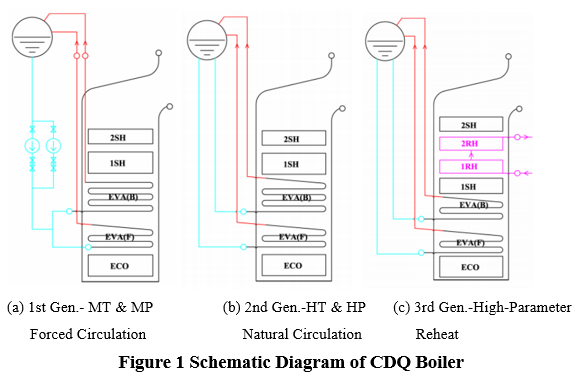
1) First Generation-Medium-Temperature, Medium-Pressure Forced Circulation Boiler and Power Generation Technology Features
(1) Landmark Projects:
1981, Muroran CDQ, Japan;
1985, Baosteel Phase I CDQ;
2000, Shougang No.1 & 2 CDQ;
2003, WISCO No.1 & 2 CDQ.
(2) Main Technical Features of Boiler:
Medium temperature & Medium Pressure + forced circulation;
Bare-tube membrane wall + fire brick chamber wall / membrane wall;
Main steam parameters (example): 3.8 MPa, 450 °C.
2) Second Generation - High-Temperature & High-Pressure Natural Circulation Boiler Power Generation Technology Features
(1) Landmark Projects:
1982, Nagoya No.4 CDQ, Japan;
1986, Yawata Steel Works 175 t/h CDQ, Japan;
2005, Jigang 150 t/h CDQ;
2009, Shougang Jingtang No.1 & 2 CDQ, 260 t/h.
(2) Main Technical Features of Boiler:
High temperature/pressure + natural circulation;
Membrane wall;
Main steam parameters (example): 9.8 MPa, 540 °C.
3) Third Generation - (Ultra-)High-Temperature & Ultra-High-Pressure + Primary Reheat Boiler and Power Generation Technology Features
(1) Landmark Projects:
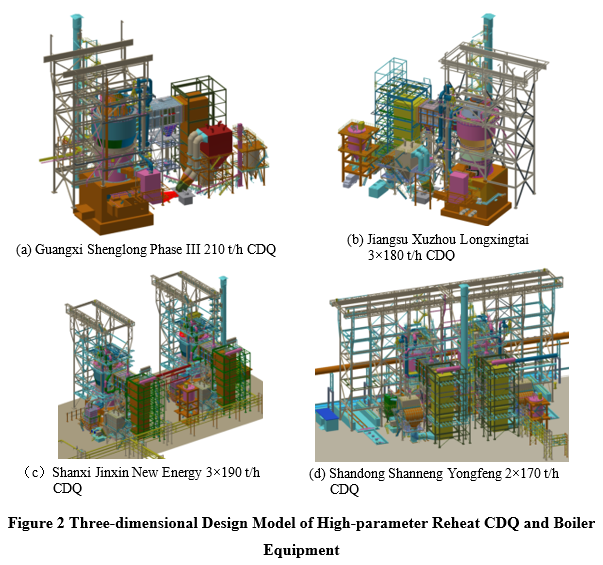
2022, Guangxi Shenglong 210 t/h CDQ;
2023, Jiangsu Longxingtai 3×180 t/h CDQ;
2026, Shanneng Yongfeng 2×170 t/h CDQ.
(2) Main Technical Features of Boiler:
(Ultra-)high-temperature, ultra-high-pressure single reheat + natural circulation;
Membrane wall;
Reheat high-speed turbo-generator unit;
Main steam parameters (example): 13.8 MPa, 540/571 °C;
Reheat parameters (example): 3.0 MPa, 540/571 °C.
3 Innovation and Application of Third-Generation CDQ Waste Heat Power Generation Technology
As CDQ technology advanced toward larger scales, and the operational parameter optimization potential of second-generation CDQ waste heat boiler and power generation technology reached its limits, it became increasingly difficult to meet the demands for ultimate energy efficiency and carbon reduction through energy conservation. The characteristics of large-scale CDQ units-high flue gas volumes and high main steam output-were not fully compatible with efficient high-parameter reheat turbine units. Therefore, a comprehensive set of fundamental technical theories needed to be established and applied in engineering practice.
BSIET, BJCEEE, and other organizations, after gradually improving technical challenges such as load fluctuations, thermal fatigue, and abrasion corrosion in coke oven and CDQ systems, first applied third-generation CDQ waste heat power generation technology in the Guangxi Shenglong 210 t/h CDQ project in May 2022, building a CDQ system with single ultra-parameter reheat boiler and power generation. After rigorous performance testing, the power generation per ton of coke at the Guangxi Shenglong 210 t/h CDQ project increased by approximately 14% compared to the second generation. Subsequently, projects such as Jiangsu Longxingtai 3×180 t/h CDQ and Shanneng Yongfeng 2×170 t/h CDQ successfully implemented dual ultra-parameter reheat power generation technology, increasing power output by approximately 18% over the second generation, further enriching the portfolio of third-generation CDQ waste heat power generation applications.
These landmark projects not only verified the reliability of third-generation CDQ waste heat power generation technology, but also addressed the urgent demands of large-scale CDQ for intensive layout, high self-power generation rates, and "energy conservation and carbon reduction" in the steel and coking industries.
Through the implementation of the 14th Five-Year Plan, basic energy efficiency in the steel and coking industries has steadily improved. However, existing inefficient equipment, high-carbon energy structures, and bottlenecks in low-carbon industrialization continue to constrain the carbon reduction potential. Facing the dual rigid targets of energy consumption and carbon intensity, and in alignment with the 15th Five-Year Plan carbon peaking action plan and key industry energy conservation and carbon reduction deployment, the steel industry has entered a deep-water zone of synergistic energy-carbon transformation. Third-generation CDQ waste heat power generation technology has emerged as a reliable technical choice for improving energy and carbon efficiency in the industry.
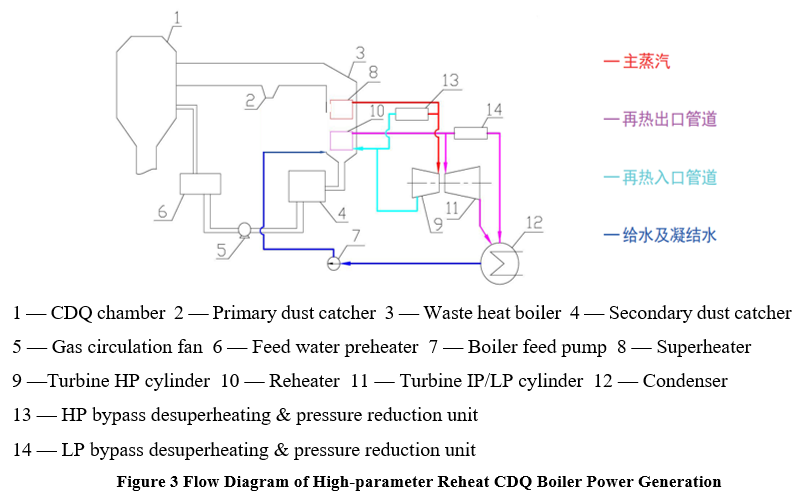
3.1 Technical Principles and Process Flow
Compared with the traditional Rankine Cycle, the high-parameter CDQ power generation technology incorporates a reheat process. The main steam generated by the boiler performs work in the high-pressure (HP) cylinder of the steam turbine. The exhaust steam from the HP cylinder is extracted through the cold reheat pipeline, re-enters the boiler, and is heated by the reheater to the same temperature as the main steam. It then enters the intermediate/low-pressure (IP/LP) cylinders of the steam turbine through the hot reheat outlet pipeline to perform work. The reheat process adds a secondary enthalpy increase to the steam, improving the exergy fraction of the turbine while maintaining the same exhaust parameters. Compared with conventional medium-temperature & medium-pressure and high-temperature & high-pressure parameters, the boiler produces higher-quality steam with reduced exhaust volume and lower cold-source losses in the turbine, thereby improving overall efficiency [1,2].
Steam-water flow process of high-parameter reheat CDQ boiler power generation:Demineralized water tank — Deaerator feed pump — Feed water preheater — Deaerator — Boiler feed pump — Economizer — Steam drum — Evaporator — Superheater —Turbine HP cylinder — Reheater — Turbine IP/LP cylinder — Condenser — Condensate — Demineralized water tank
3.2 Key Technical Indicators
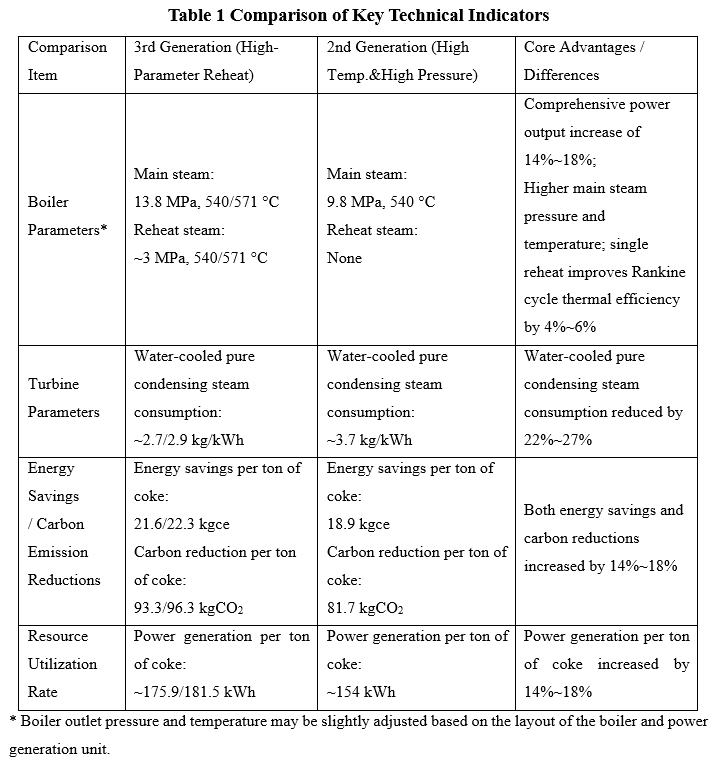
Compared with the second-generation high-temperature, high-pressure CDQ power generation technology, the third-generation high-parameter reheat technology achieves a leapfrog upgrade in core performance. With higher steam parameters and reheat cycle processes, it significantly improves thermoelectric conversion efficiency and reduces steam consumption for power generation. All three key indicators—power generation per ton of coke, energy conservation, and carbon reduction—show improvements of 14%~18%, making it a breakthrough advanced technology for low-carbon, high-efficiency CDQ [3].
3.3 Technical Features
Long-standing common challenges in the CDQ waste heat power generation field—such as "insufficient utilization of thermal energy grade, poor system operational stability, and low energy conversion efficiency"—were addressed through interdisciplinary collaborative research, leading to the successful development of the "Third-Generation CDQ Waste Heat Boiler and Power Generation Technology." With "high parameters, reheat cycle, and intelligent integration" as the core pathway, a full-chain technological innovation was achieved spanning thermal cycling, system integration, and operational control. The system establishes a high-parameter reheat cycle with a dual safety protection framework, incorporating intelligent safety interlocking and enhanced control systems suitable for full CDQ operation, achieving long-life, high-efficiency CDQ waste heat boilers and high-efficiency reheat high-speed condensing steam turbines, successfully realizing ultimate energy efficiency upgrades. In recent years, while accumulating application experience with third-generation CDQ waste heat boiler and power generation technology, operational reliability and compatibility have been further enhanced. Currently, with intensifying environmental regulation, enterprise demand for backup CDQ installations has significantly increased. When enterprises adopt this technology for backup CDQ, it can simultaneously accommodate existing old CDQ, enabling coordinated upgrade and renovation.
(1)Boiler Heating Surface Material Enhancement
Targeted research was conducted on the effects of CDQ flue gas on sulfidation corrosion and erosion wear of boiler tubes. The third-generation CDQ waste heat boiler and power generation system optimized heating surface materials, with the superheater and reheater selecting TP347H and TP321H high-temperature-resistant alloy tubes, enhancing the operational safety factor of equipment tubing [4,5].
(2)Thermal System Safety Interlocking System
An independent emergency desuperheating and pressure reduction protection unit is provided, diverting steam from the main steam pipeline to the reheater. This not only protects the reheater, but also—beyond the previous two options of either venting the medium directly to atmosphere or using desuperheated and depressurized steam as plant low-pressure steam—can recover condensate through the LP bypass. This enables turbine shutdown without boiler shutdown, ensuring continuous CDQ production. In the event of a power generation unit failure, the HP/LP bypass systems can be rapidly activated to recover the working fluid.
(3)Application of Intelligent Safety Interlocking and Enhanced Control System
CDQ coke charging and discharging operations are cyclical in nature, with continuous fluctuations in circulating gas flow rate and temperature, resulting in heat source stability far below that of conventional coal-fired power plants. When adopting the "multiple boilers, one turbine" header-main pipe configuration with high-parameter reheat complex systems, operational fluctuations from a single boiler can spread along the steam header to the entire system, easily triggering cascading operational anomalies. Traditional PID control and independent unit control logic can no longer accommodate such multi-variable, strongly coupled complex systems, placing extremely high demands on the real-time performance and predictive capability of the control system.
To address this, and to establish an integrated control system of "source stabilization — process enhancement — safety closed-loop," the third-generation technology incorporates a system-wide intelligent safety interlocking and enhanced control system that flexibly adapts to individual CDQ loads.
The intelligent safety interlocking between the boiler and turbine is configured with millisecond-level, multi-dimensional protection logic at the safety level, covering various abnormal conditions including steam temperature, pressure, drum water level, and turbine trip. For example, when a sudden turbine trip occurs, the system instantaneously activates the bypass unit to prevent overheating and damage to the reheater. Through this intelligent safety interlocking, dynamic load balancing of "multiple boilers, one turbine" in header-main pipe mode can be achieved, effectively offsetting the impact of periodic heat source fluctuations, ensuring long-term stable equipment operation across a wide load range, and significantly reducing safety hazards from manual misoperation.
The augmented control system relies on industrial Ethernet and intelligent gateways to collect hundreds of operational parameters in real time, enabling online data statistics and period-over-period comparisons, transforming passive fault handling into proactive condition prediction. Based on changes in boiler inlet flue gas temperature parameters and CDQ heat source fluctuations, the augmented control system automatically adjusts coke discharge volume and circulating gas flow to balance heat source input, suppress severe operational fluctuations, and strengthen proactive load regulation at the CDQ core, thereby maximizing the stability of steam generation and power output.
4 Promotion Prospects and Outlook
The third-generation CDQ waste heat power generation technology was successfully included in the "Hebei Province 2024 Steel Industry Advanced Process Technology and Equipment Recommended Catalog" published by the Hebei Provincial Department of Industry and Information Technology. In 2024, the China Coking Industry Association convened the 3rd China Coking Industry Science and Technology Conference, where this technology was awarded the Coking Technology Innovation Achievement Award and recognized as an Outstanding Application Case. In 2025, the China Iron and Steel Association officially included this technology in the "Steel Industry Energy Conservation and Carbon Reduction Technology Implementation Guide" and the "Steel Ultimate Energy Efficiency Capability List (2025 Edition)." In June 2026, the "Three-Year Action Plan for Energy Conservation and Carbon Reduction Transformation in Key Industries" issued by the National Development and Reform Commission and other departments explicitly stated that the steel industry's "coke ovens should be equipped with high-efficiency CDQ."
4.1 Economic Benefits
The third-generation CDQ waste heat power generation technology significantly reduces enterprise energy procurement costs through thermal energy recovery and flexible system scheduling, shortens investment payback periods, and achieves remarkable economic benefits. Taking the 210 t/h CDQ project as an example: the high-parameter reheat (dual ultra-parameter) technology can achieve an annual power generation of approximately 315 million kWh, an increase of approximately 18% compared to the traditional (second-generation) technology, significantly improving the enterprise's energy self-sufficiency rate. At a grid-connected electricity price of CNY 0.5/kWh, the net power generation revenue per ton of coke reaches CNY 90.75. Compared with high-temperature, high-pressure technology, the annual incremental profit can reach approximately CNY 23.85 million, with a payback period of only 1-2 years for the technology increment investment.
4.2 Social Value
The third-generation CDQ waste heat power generation technology provides a replicable model of "new quality productive forces" for the green and low-carbon transformation of the traditional steel and coking industries. Taking the 210 t/h CDQ project as an example: the high-parameter reheat (dual ultra-parameter) technology achieves an annual power generation of approximately 315 million kWh, reducing CO2 emissions by 96.3 kg per ton of coke, with annual SO2 emission reductions of approximately 26 tons and NOx reductions of approximately 42 tons, effectively improving regional air quality. Compared with high-temperature, high-pressure technology, annual CO2 emissions are reduced by approximately 25,300 tons, and standard coal consumption is saved by approximately 5,861 tons per year.
4.3 Application Scope
The third-generation CDQ waste heat power generation technology is suitable for both new construction projects and energy-saving technical renovations, offering broad applicability. It is applicable to waste heat power generation projects supporting new CDQ installations of various scales from 125 to 260 t/h, particularly suitable for large integrated steel enterprises pursuing ultimate energy efficiency and Grade-A environmental performance. It is also suitable for the upgrade and renovation of traditional medium-temperature/medium-pressure or high-temperature/high-pressure CDQ waste heat power generation units, achieving energy efficiency leaps through replacement with high-parameter reheat boilers and steam turbines.
For situations where the third-generation high-parameter steam turbine generator requires maintenance or temporary shutdown due to faults, and no backup high-parameter generating unit is available on-site, the owner can retrofit a second-generation high-temperature, high-pressure unit for temporary operation while maintaining continued operation of the high-parameter boiler. The high-parameter boiler's emergency desuperheating and pressure reduction unit is used to process the high-parameter main steam and protect the reheater. The regulated reheat-stage steam is then delivered to the old high-temperature, high-pressure unit for sliding-parameter operation.
5 Conclusion
CDQ waste heat power generation technology has undergone three iterations, with each technological innovation achieving significant economic, social, and environmental benefits. Looking ahead, CDQ waste heat power generation technology will continue to iterate and innovate, steadily upgrading toward higher parameters, deeper energy conservation, and smarter, more efficient operation, continuously empowering the low-carbon transformation and green, high-quality development of the steel and coking industries.
References:
[1] Liu Yi. Brief discussion on CDQ waste heat boiler design [J]. Waste Heat Boiler, 2011, (2): 13-14.
[2] Zhang Lizhi, Wang Ruifeng, Yao Runxian. Exploration of ultra-high-speed industrial steam turbine technology [J]. Metallurgical Management, 2019, (5): 49.
[3] Ji Bingquan, Lin Song, Zhao Henglin, et al. Development and application of high-parameter CDQ waste heat power generation technology [J]. Coal Chemical Industry, 2026, 54(1): 52-54.
[4] Huang Xin, Li Wei, Wang Weinan. Analysis and countermeasures for superheater tube rupture in CDQ waste heat boilers [J]. Waste Heat Boiler, 2024, (2): 19-20.
[5] Wang Chunlei, Luo Fei, Liu Yi. Comparative analysis of boiler hardness requirements in DL/T438-2016 and other standards [J]. Waste Heat Boiler, 2017, (2): 20-21.